Build conductive pathways
Individualized, high-aspect-ratio nanotubes can connect active particles across longer distances than conventional particulate conductive additives.

Carbon nanotubes for battery manufacturers
Industrial MOLECULAR REBAR® carbon nanotube dispersions and conductive additives engineered for lithium-ion and lead-acid battery manufacturing.
Why it matters
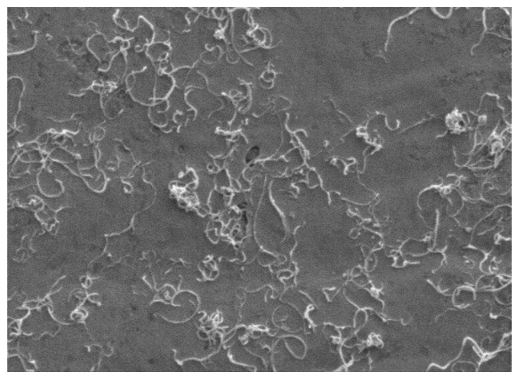
Carbon nanotubes (CNT) are high-aspect-ratio nanomaterials that can form long conductive and reinforcing pathways through battery active material. Raw CNT naturally forms difficult bundles, so BDS individualizes, protects, and disperses the nanotubes in application-ready formulations matched to the target chemistry and manufacturing process.
Review original performance data →Battery applications
The useful result depends on CNT dispersion quality, loading, battery chemistry, and the surrounding formulation. BDS develops the material and validation plan around those variables.
Individualized, high-aspect-ratio nanotubes can connect active particles across longer distances than conventional particulate conductive additives.
A well-integrated CNT network can reduce electrical limitations that restrict current flow at higher charging rates.
Nanotube networks can provide mechanical reinforcement through the electrode structure as the battery cycles.
BDS supplies formulation and integration support for lithium-ion and lead-acid processes from development quantities through commercial formats.
Original BDS evidence
BDS combines material processing, electrode imaging, cell testing, and manufacturer validation. Results remain chemistry-, formulation-, and test-specific.
The BDS process
Separate bundled CNT into discrete, high-aspect-ratio structures.
Maintain tube integrity and surface behavior through processing.
Tailor the dispersion for the target chemistry and process.
Create conductive pathways through battery active material.
Explore CNT technology
Technical FAQ
High-aspect-ratio CNT can create conductive pathways and mechanical reinforcement through active material, supporting power, charging, and cycle-life goals.
A formulated dispersion addresses bundling, wetting, dosing, and integration so manufacturers can use CNT performance more consistently in their process while mitigating the safety concerns of raw CNT.
BDS develops Molecular Rebar formulations for lithium-ion and lead-acid applications, with testing and integration support matched to the customer system.
Yes. BDS supports 10 L jugs, 208 L drums, and 1,200 L totes for development through commercial-scale production.
Technical content reviewed by the Black Diamond Structures battery development team. Last updated August 2026.
Working together
Strategic relationships that strengthen our materials expertise, production capabilities, and support for battery manufacturers.

Start a technical conversation
Bring us your chemistry, production process, and performance target.
Talk to technical sales →